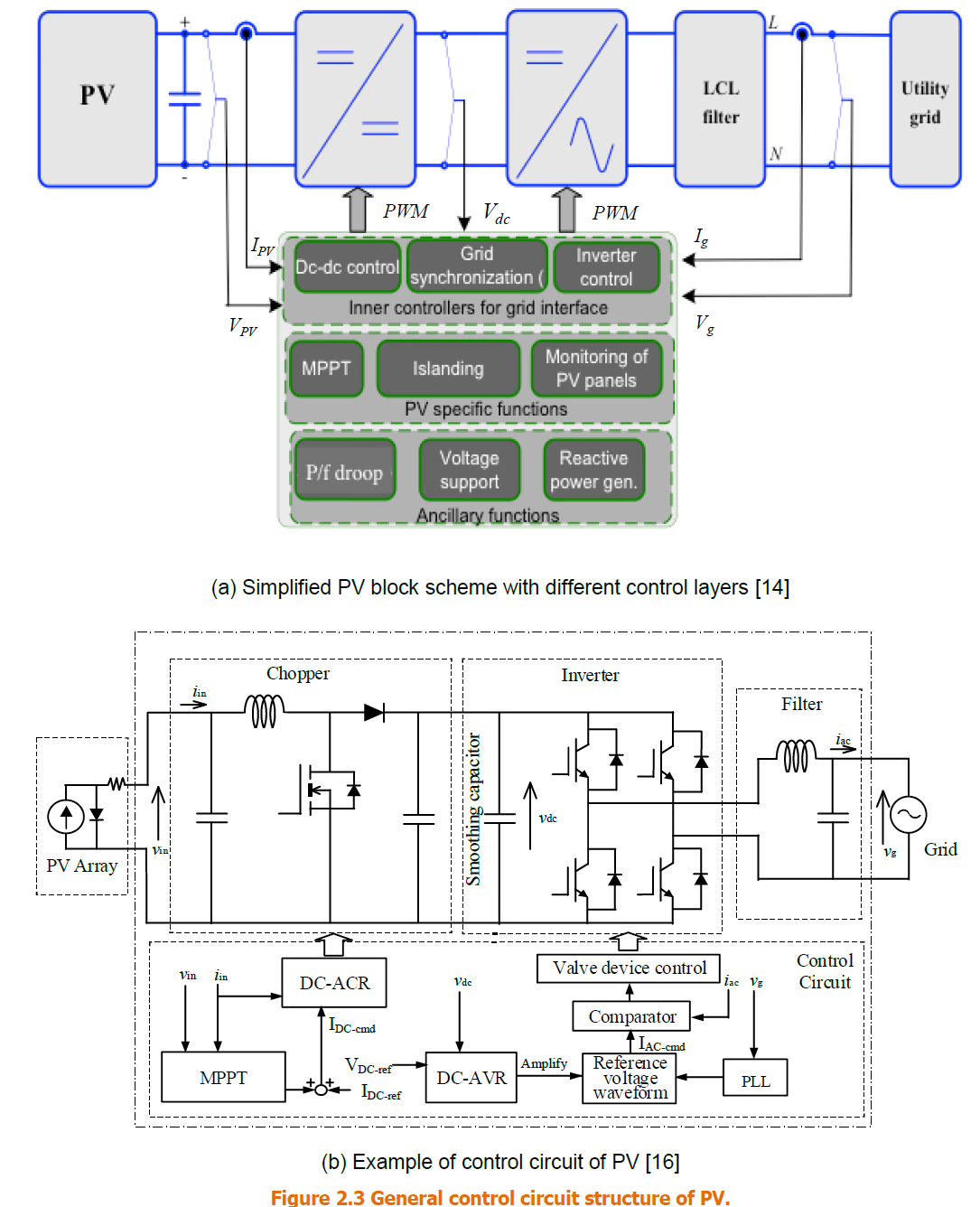
Why does a grid code enter a modelling page? Because the control is flexible software, a code can ask the inverter to do far more than inject power — and each function you switch on is another block your model may need.
Two documents recur. EU 2016/631 is the European network code “Requirements for Generators” (RfG); IEEE 1547 is the distributed-energy-resource interconnection standard used mainly in North America. Between them they can require support functions such as negative-sequence current injection, reactive current from a power-factor command, a capped reactive-current injection, and reactive current whose level tracks the depth of a voltage dip. Table 1 gathers the most relevant requirements from these two.
Read Table 1 as a high-level teaching summary, not as a substitute for project-specific grid-code compliance. None of these functions is always active in every inverter: what applies depends on the grid code, the connection voltage, the plant size, the country and the project. In modelling, the rule is not to switch on every function, but to include only the ones the study objective and the required grid-code behaviour actually call for.
A plain ✓ means one or more classes of IBG must meet the requirement; a bracketed (✓) marks a non-mandatory one. The individual ticks matter less than the direction of travel — each revision asks the inverter to do more. In plain English, the key functions are:
- P(f) — active power changes as the frequency changes (for example, backing power off when the frequency runs high).
- Q(V) — reactive power or current changes as the voltage changes, to help hold the voltage.
- P(V) — active power changes as the voltage changes, usually to manage an over-voltage or a voltage recovery.
- Synthetic inertia — a fast active-power response designed to imitate the inertial support a spinning machine would give.
- ROCOF immunity — the inverter must stay connected through an acceptable rate of change of frequency, rather than nuisance-tripping.
- Fault ride-through (FRT) — the plant must stay connected through specified voltage dips (low-voltage ride-through, LVRT) or swells (high-voltage ride-through, HVRT).
- Dynamic voltage support — reactive-current injection during a voltage disturbance to prop the voltage up.
- Power oscillation damping (POD) — active- or reactive-power modulation that damps power-system oscillations.
- Black start — the ability to energise a dead section of network without an external grid voltage to lock onto.