
United Kingdom
Click to view details
UK Registered Office
Address18 Canberra Road
Gretna, Dumfriesshire
Scotland
DG16 5DP
Gretna, Dumfriesshire
Scotland
DG16 5DP
Text can be selected and copied.
RMS and EMT-based assessment of dynamic stability, weak-grid behaviour, harmonic and control interactions, and subsynchronous phenomena in converter-dominated power systems.
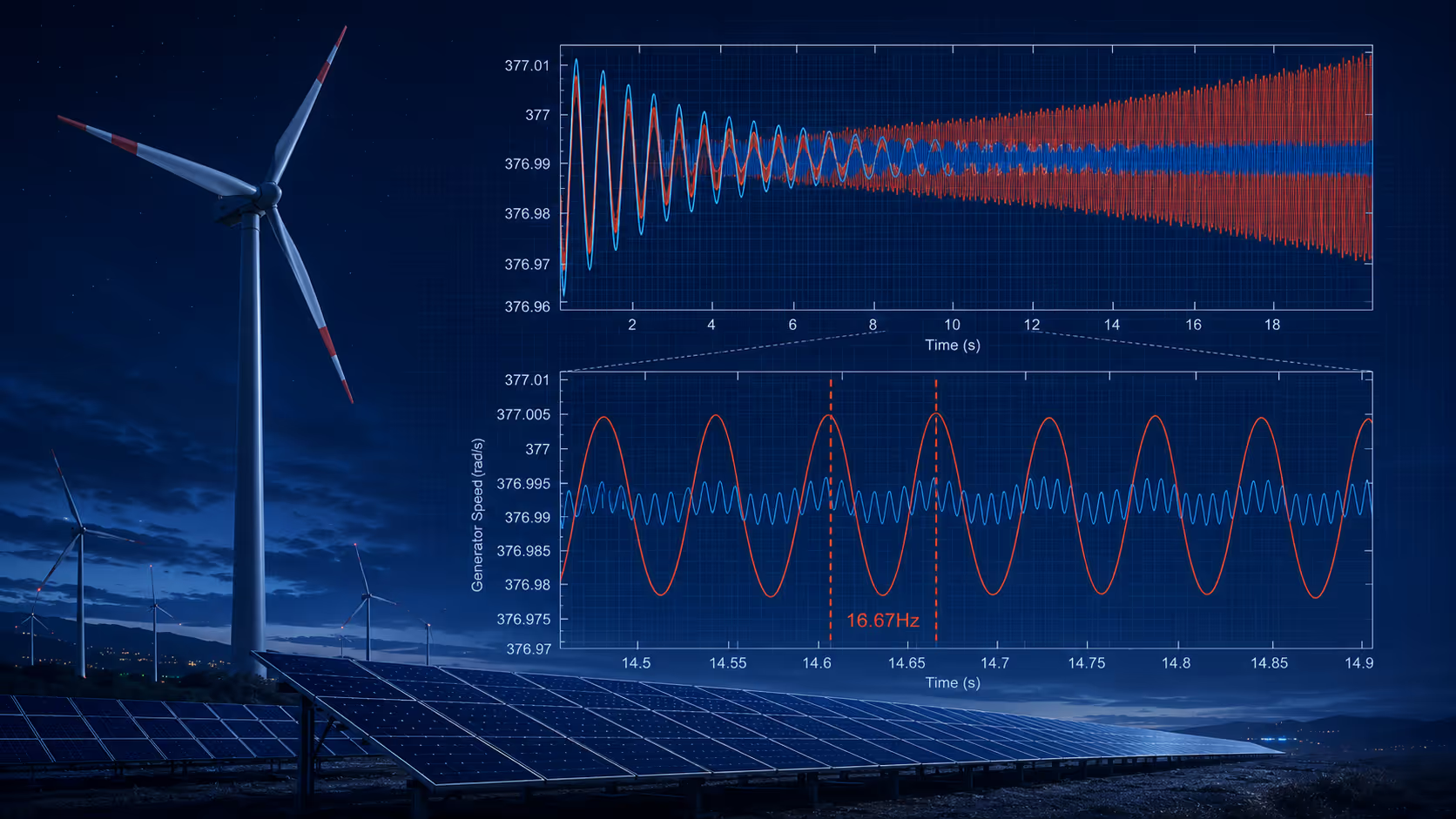
Specialist RMS and EMT studies for dynamic stability, weak-grid and converter-grid interaction, IBR performance, subsynchronous phenomena, harmonic resonance and control interaction in inverter-based and HVDC-rich networks, aligned with IEEE, IEC and CIGRE methodologies.
APS provides advanced RMS and EMT-based studies for complex, evolving power systems, with particular focus on dynamic stability, weak-grid behaviour, harmonic and control interactions, subsynchronous phenomena and converter-dominated network performance. These studies support developers, asset owners, OEMs, consultants, TSOs, DSOs and DNOs during grid connection, design verification, technical due diligence and operational planning.
Modern power systems are increasingly influenced by inverter-based resources (IBRs), long cable networks, power electronic converters, FACTS devices, HVDC links, battery energy storage systems (BESS) and complex protection and control schemes. These technologies can introduce dynamic and control interactions that are not always visible through conventional load-flow or short-circuit studies.
APS applies simulation-based engineering assessment using RMS, EMT, frequency-domain and control-system analysis methods to identify risks, verify performance and support practical mitigation. The work is carried out in line with recognised international frameworks, including IEEE 2800 and IEEE 2800.2, IEEE Std 1110 and IEEE Std 1204, IEC 61400-21-1 and IEC 61400-27, IEC 62747 and the IEC 61000 series, together with relevant CIGRE Technical Brochures covering system strength, converter interaction, impedance-based stability and grid-forming performance.
Studies can be performed using DIgSILENT PowerFactory, PSCAD™/EMTDC™, EMTP®, PSS®E and RSCAD/RTDS. APS can assess normal operating conditions, fault and switching events, weak-grid and low-SCR scenarios, control interactions, resonance conditions and recovery behaviour. Where required, mitigation options including control parameter tuning, grid-forming functionality, filtering, damping schemes, system-strength remediation and protection coordination can be evaluated.
APS provides study-led grid dynamics services for projects where converter-based generation, HVDC, FACTS or weak-grid conditions may introduce stability, resonance or control-interaction risks. The service combines detailed dynamic modelling, model validation, frequency-domain screening, time-domain simulation and mitigation design.
These studies are suitable for projects where inverter-based resources, HVDC links, long cable networks or weak-grid conditions may introduce dynamic stability, resonance or control-interaction risks, particularly where low short-circuit ratio, high converter penetration or sensitive control systems increase the likelihood of adverse interaction.
The objective of the study is to provide a technically justified assessment of dynamic stability, weak-grid behaviour, resonance and control-interaction risks before they become connection, compliance, design or operational issues.
APS combines detailed RMS and EMT modelling with frequency-domain and control-system analysis to help clients understand how inverter-based resources, HVDC, FACTS and complex control schemes interact with the wider network. The study can identify whether stability margins, damping performance, harmonic and resonance behaviour, and converter response under weak-grid conditions are within acceptable limits, and whether mitigation is required.
The assessment supports early design decisions, grid connection compliance, control parameter selection, equipment specification, system-strength evaluation and mitigation system optimisation, in line with applicable IEEE, IEC, CIGRE and connection-code requirements. This allows project teams to move from uncertainty to a clear engineering position supported by modelling evidence, validated models and technically robust recommendations.
By combining RMS, EMT and frequency-domain simulation with validated equipment models, network data, fault-level information and control representations, APS helps clients reduce stability and resonance risks, demonstrate connection compliance, optimise control and mitigation strategies, and ensure that dynamic performance requirements have been properly considered.