
United Kingdom
Click to view details
UK Registered Office
Address18 Canberra Road
Gretna, Dumfriesshire
Scotland
DG16 5DP
Gretna, Dumfriesshire
Scotland
DG16 5DP
Text can be selected and copied.
Specialist cable sizing, ampacity and thermal rating studies for underground, subsea, industrial and utility-scale MV, HV and EHV cable systems — determining safe continuous, cyclic, emergency and short-time current ratings for practical project conditions.
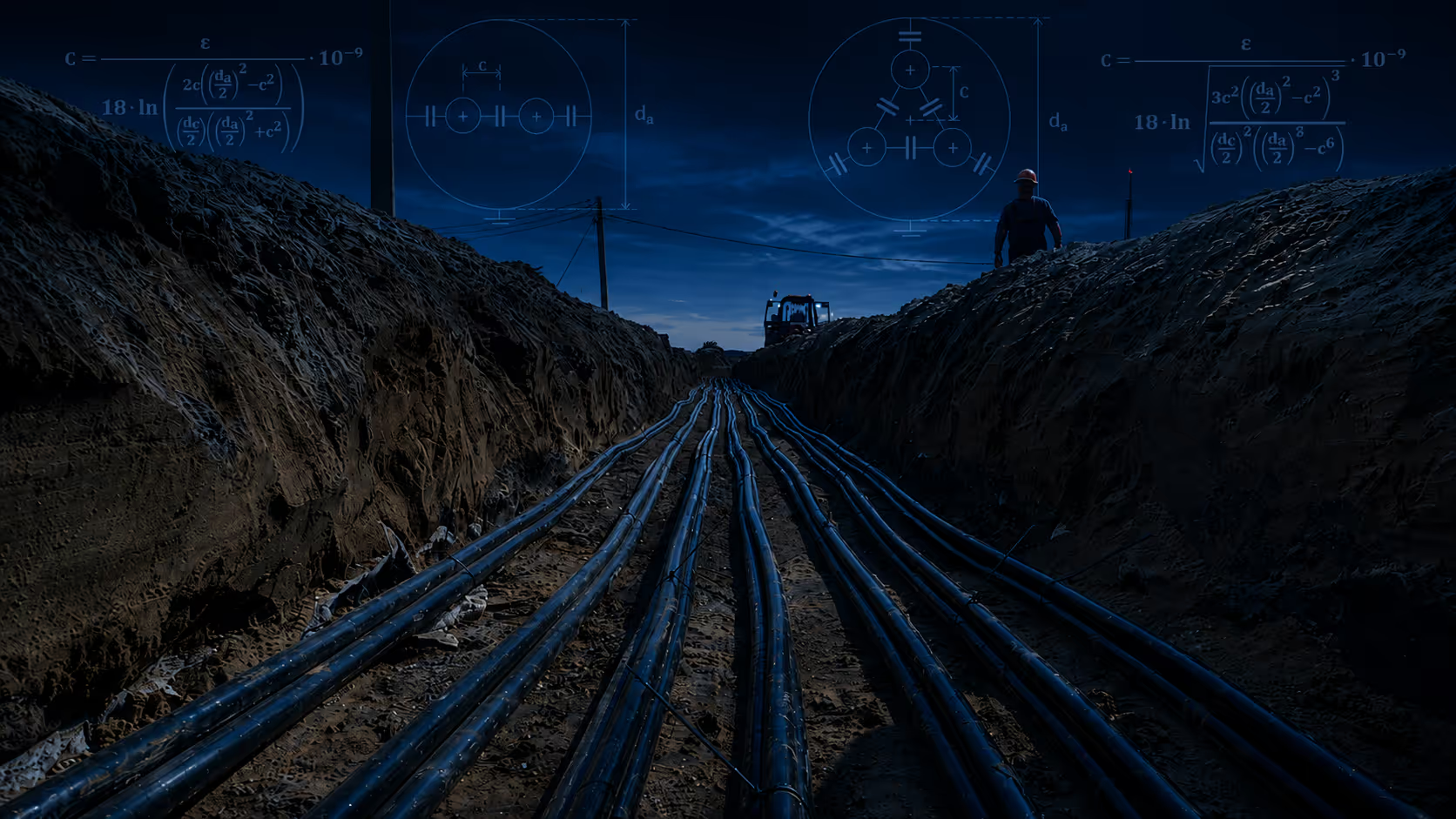
Cable rating is not governed by conductor size alone. A reliable cable design requires consideration of cable construction, installation depth, trench arrangement, duct configuration, soil thermal resistivity, load profile, bonding arrangement, sheath and armour losses, grouping effects, thermal backfill, dry-out risk and mutual heating between adjacent circuits.
APS provides specialist cable sizing, ampacity and thermal rating studies for underground, subsea, industrial and utility-scale cable systems. The service supports the selection and verification of MV, HV and EHV cable circuits by determining the maximum permissible continuous, cyclic, emergency and short-time current that a circuit can carry without exceeding the thermal limits of the conductor, insulation, sheath, screen, armour, joints or the surrounding installation environment.
Cable rating is not governed by conductor cross-section alone. A thermally sound cable design requires systematic consideration of cable construction, installation depth, trench and duct configuration, ambient temperature, soil thermal resistivity, load profile, bonding arrangement, sheath and armour losses, grouping derating, thermal backfill performance, soil dry-out risk, and mutual heating from adjacent circuits, buried services and nearby heat sources. Failure to account for these factors can lead to sustained over-temperature, premature insulation ageing and reduced asset life, or to unnecessary over-sizing and avoidable cost.
The thermal rating assessment is carried out using recognised engineering methods aligned with IEC 60287 for steady-state current rating, IEC 60853 for cyclic and emergency loading, the Neher-McGrath thermal rating approach, CIGRE technical guidance and relevant IEEE engineering practice. These are not competing methods but complementary analytical frameworks applied according to installation complexity, load profile and project requirement. Where the installation geometry or loading conditions warrant detailed simulation, specialist cable rating platforms including CYMCAP and Cableizer are used for detailed thermal modelling, mutual heating analysis and cross-verification. National sizing requirements such as AS/NZS 3008 can also be applied where the project demands it.
For cable bonding and sheath assessment, EMT simulation using EMTP® and PSCAD™/EMTDC™ is applied where transient analysis is required — including sheath overvoltage under switching and fault conditions, bonding conductor performance during earth faults, cross-bonding transient behaviour, and sheath voltage limiter (SVL) assessment under lightning and switching impulse. This allows bonding arrangements and SVL protection to be evaluated against both steady-state circulating current limits and the transient voltages that occur under fault and switching conditions.
APS supports projects from early-stage cable option studies through to detailed design verification, independent review of third-party calculations, connection application support and asset uprating assessment.
APS provides study-led cable rating services spanning early-stage option studies through to detailed design verification and independent technical review. The service combines thermal modelling, installation-environment assessment, loss calculation, bonding analysis and practical installability review.
These studies are applicable to any project where cable thermal performance, current-carrying capacity or installation feasibility needs to be verified — particularly where route constraints, soil conditions, load profile or adjacent heat sources increase the complexity of the rating assessment.
The objective of the study is to confirm that the proposed cable system is thermally suitable, practically installable, technically justified and capable of supporting the required operating duty with adequate design margin — providing clear, defensible evidence to support design review, connection approval and asset management decisions.
APS supports early-stage option studies, detailed design verification, connection applications, asset uprating, cable replacement projects and independent review of third-party calculations. By combining IEC- and CIGRE-aligned rating methods with realistic installation-environment modelling — soil resistivity, backfill performance, grouping, bonding arrangement and mutual heating — the assessment captures the factors that determine real-world thermal performance, not just the factors that are straightforward to calculate.
The study identifies whether the cable system will operate within safe thermal limits under steady-state, cyclic and emergency loading conditions, and whether the design margin is appropriate for the required asset life and operating regime. Where a constraint is identified, the assessment evaluates the impact and supports the selection of a technically justified and cost-effective mitigation — whether a revised conductor size, an adjusted installation arrangement, a thermal backfill specification, a modified bonding scheme or a revised operating limit.
By combining recognised thermal rating methods with detailed installation modelling and practical engineering judgement, APS helps clients avoid both under-rating, which creates thermal risk and reduces asset life, and over-rating, which results in unnecessary cost — and provides the technical evidence required for design sign-off, connection approval and long-term asset management.