
United Kingdom
Click to view details
UK Registered Office
Address18 Canberra Road
Gretna, Dumfriesshire
Scotland
DG16 5DP
Gretna, Dumfriesshire
Scotland
DG16 5DP
Text can be selected and copied.
APS provides specialist power quality measurement, monitoring, analysis and reporting for commercial, industrial, renewable energy, EV charging, data centre and utility-connected installations — identifying disturbance sources, verifying compliance with recognised limits and supporting practical mitigation to improve reliability, efficiency and equipment performance.
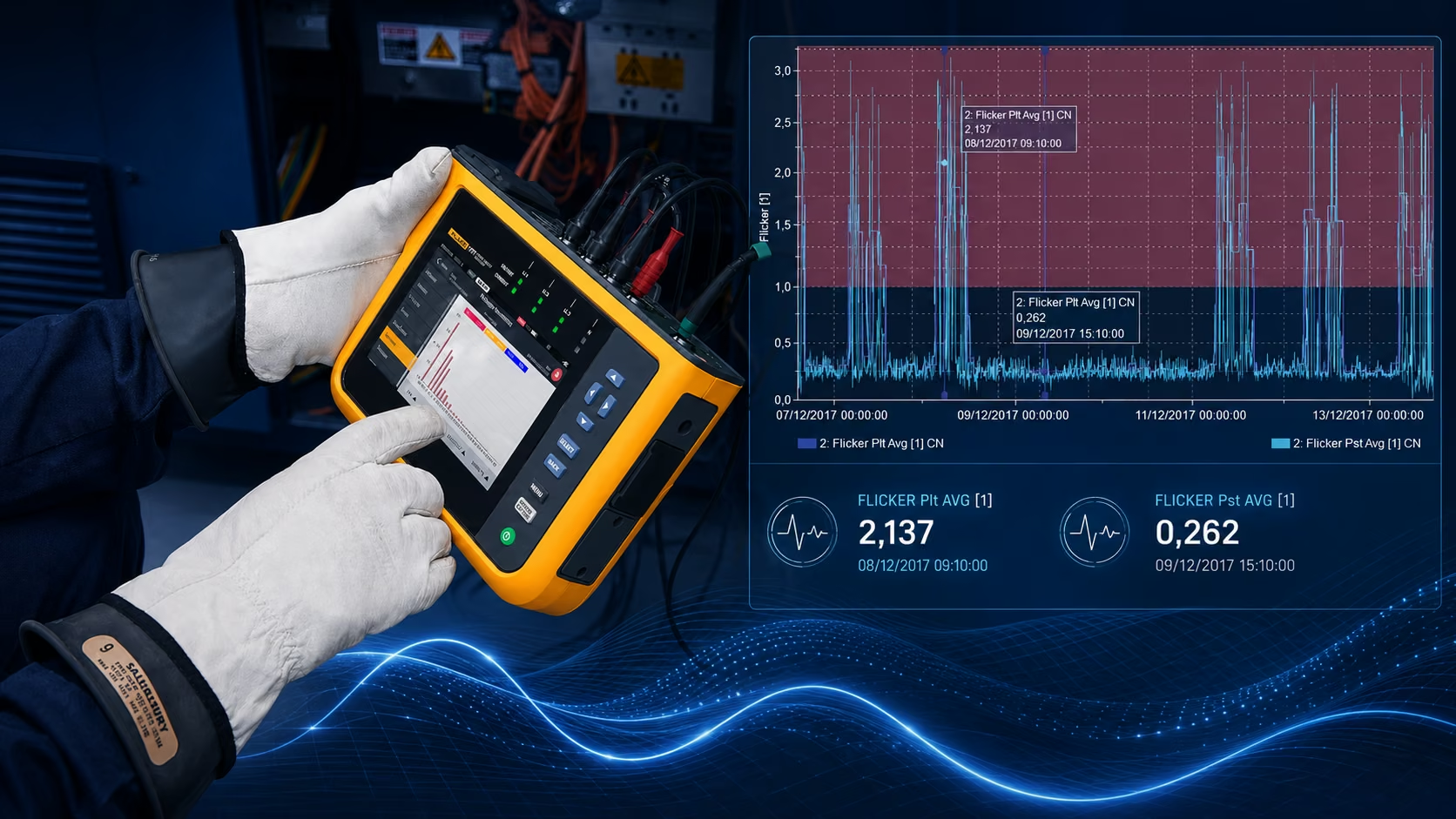
Specialist LV, MV and HV power quality surveys, long-term monitoring and standards-based compliance assessment — Class A measurement per IEC 61000-4-30, covering harmonics, flicker, voltage events, unbalance, transients and supraharmonics, with reporting against EN 50160, IEEE Std 519 and applicable utility criteria.
Modern electrical networks are increasingly shaped by non-linear loads, inverter-based generation, variable-speed drives, EV chargers, UPS systems, power electronics, transformer energisation and capacitor switching, alongside sensitive digital infrastructure. These conditions introduce harmonic and interharmonic distortion, voltage unbalance, flicker, voltage dips, swells and interruptions, rapid voltage changes, transient overvoltages and excessive neutral currents. Left unassessed, these disturbances lead to nuisance tripping, equipment overheating, insulation stress, premature failure, maloperation of protection devices and reduced system availability.
Power quality problems are rarely the consequence of a single source. More commonly, they result from the cumulative effect of multiple non-linear loads sharing a common network impedance, or from the interaction between the internal installation and the supply network. A voltage dip at a sensitive piece of equipment may originate in the distribution network, in the LV installation, in a switched load elsewhere on the same busbar, or in a combination of all three. Accurately identifying the source — and the relative contribution of supply-side and installation-side factors — is essential to selecting a technically effective and cost-proportionate response.
APS supports clients through site-based power quality surveys, short-term troubleshooting measurements and long-term monitoring using advanced Class A three-phase power quality analysers. Measurements capture voltage, current, frequency, power, energy, harmonic and interharmonic distortion, supraharmonics, flicker, unbalance, transients, inrush current, waveform deviation and time-stamped event records. The assessment is aligned with IEC 61000-4-30 Class A measurement methods, EN 50160 supply voltage characteristics, IEEE Std 519 harmonic limits and IEC 61000-2-2 compatibility levels, together with applicable utility, grid code and client-specific requirements.
APS converts raw measurement data into clear technical conclusions. The deliverable is a defensible technical position — not simply a collection of logged values — establishing whether a problem originates in the supply network, the internal installation, connected equipment, a specific switching event or the interaction between multiple power electronic systems, and setting out what needs to be done about it.
IEC 61000-4-30 defines the measurement methods, aggregation intervals and uncertainty requirements for power quality parameters and classifies instruments into performance classes. Class A instruments meet the most stringent specification for measurement accuracy, time synchronisation and uncertainty, and their results are accepted for contractual and compliance purposes — including evidence submitted to network operators, national regulators and dispute resolution. APS uses Class A instruments to ensure that measurement results are technically defensible and accepted by all parties without qualification.
For compliance assessment against EN 50160, a minimum monitoring window of one week under normal operating conditions is required, with measurements aggregated at 10-minute intervals for the principal supply voltage parameters. For troubleshooting and event investigation, shorter surveys may be used, supplemented by triggered cycle-by-cycle event capture. For emission assessment, connection agreement compliance or contractual dispute purposes, the monitoring duration and aggregation are agreed against the applicable standard or network operator requirement.
Simultaneous three-phase measurements typically capture: true RMS voltage and current; frequency; active power, reactive power and power factor; harmonic and interharmonic voltages and currents to at least the 50th order; total harmonic distortion (THD) and total demand distortion (TDD); supraharmonics up to 30 kHz where required; short-term flicker severity (Pst) and long-term flicker severity (Plt); voltage and current unbalance; voltage dips, swells and interruptions with residual voltage and duration; rapid voltage changes; transient overvoltages; inrush current profiles; and time-stamped waveform captures for triggered events.
Instrument placement is selected to ensure the measurement captures conditions relevant to the investigation or compliance requirement — typically at the point of common coupling, at the equipment under assessment, or at intermediate busbars where multiple disturbance sources may interact. For complex installations, simultaneous measurements at multiple points permit source attribution and assess how disturbances propagate through the network.
The measurement scope is tailored to the project requirement and may cover a single disturbance category for a focused investigation or the full parameter set for a comprehensive compliance survey.
Measurements, analysis and compliance assessments are carried out against the principal international standards, applicable grid code and utility requirements, and any project-specific criteria agreed with the client or network operator.
The service is particularly relevant for installations with non-linear, switching or power-electronic-intensive loads, and for any site where compliance evidence is required for a connection agreement, contractual dispute or network operator acceptance.
The scope of reporting is agreed with the client at the outset and adapted to the purpose of the measurement — whether a brief troubleshooting note, a compliance submission or a full power quality management report.
APS combines field measurement, standards-based interpretation and engineering judgement to give clients a defensible technical position on power quality — not merely a data set. The distinction matters: a report that records 500 hours of waveform data without explaining what the data means, which limits apply, whether they are exceeded, and what should be done about it, does not give a client the evidence they need to make decisions or to satisfy a network operator.
Identifying whether a power quality problem is supply-side or installation-side in origin determines who is responsible for the remedy, what the appropriate mitigation is, and how it should be specified. A harmonic problem sourced in the supply network requires a different response from one sourced in on-site drives or chargers. A voltage dip caused by network faults cannot be mitigated by on-site filtering — it requires ride-through capability or a UPS. Misattributing the source leads to expenditure on the wrong remedy and persistence of the original problem.
By measuring at the right points in the installation, for the right duration, with calibrated Class A instruments, and interpreting the results against the applicable limits and the engineering context of the site, APS helps clients distinguish supply-side from installation-side issues, demonstrate compliance to network operators, target mitigation where it will be effective, and move from unexplained symptoms to a clear, evidence-based engineering conclusion.
For compliance submissions to DNOs and network operators, Class A measurement results reported against EN 50160 or IEEE Std 519 provide the level of technical evidence expected by network operators and, where required, by regulators and dispute resolution processes. The measurement and reporting methodology is documented to support the integrity and traceability of the evidence.