
Advanced Power Studies Contact Us
APS Test & Commissioning

Transformer, Reactor & Tap-Changer Testing & Diagnostics

APS provides specialist field testing, commissioning support and diagnostic condition assessment for power transformers, distribution transformers, reactors, earthing transformers, auxiliary transformers and on-load tap changers — covering the complete asset from winding system and insulation through to bushings, oil, OLTC and protection interface.
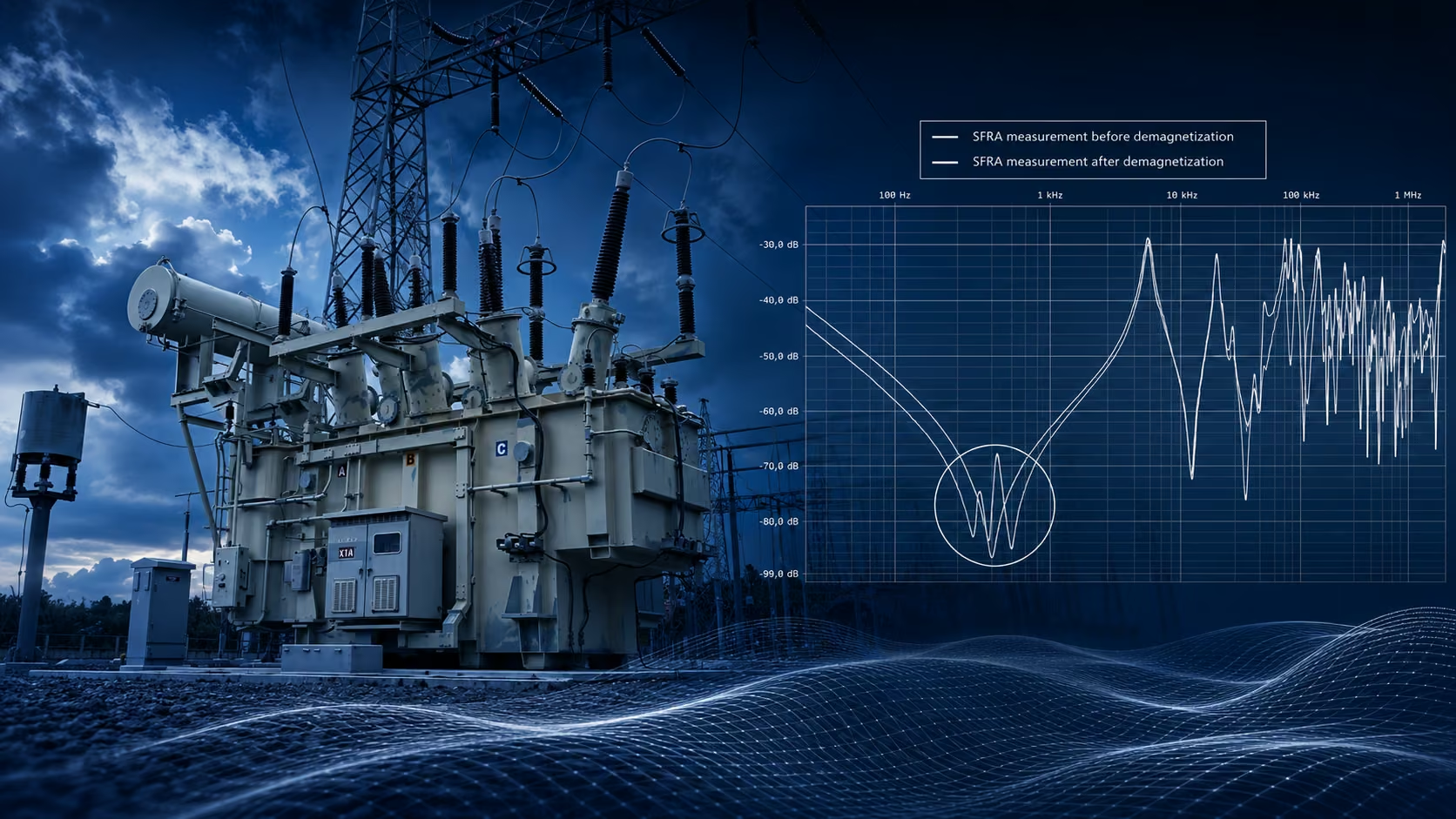
MV / HV / EHVTransformer, reactor and OLTC field testing, diagnostics and commissioning.
Transformer, Reactor & Tap-Changer Testing Services
Winding Resistance · Ratio · Tan Delta · SFRA · DGA · Bushing · OLTC
Service Scope

Transformer, Reactor & Tap-Changer Testing

MV, HV and EHV transformer, reactor and OLTC field testing, diagnostics and commissioning — winding system, insulation, core, bushings, oil, dissolved gas, SFRA, partial discharge and tap-changer assessment as an integrated diagnostic picture of asset condition.

Overview

Transformers are among the most critical and expensive assets in a power system. Their reliable operation depends on the condition of the winding system, core, insulation, bushings, tap changer, cooling system, oil or insulating fluid, protection devices, auxiliary systems and external connections. Many defects are not visible during inspection and may only be detected through structured electrical, dielectric, mechanical and oil-diagnostic testing.

APS supports transformer testing and diagnostic assessment for MV, HV and EHV assets used in substations, renewable generation plants, battery energy storage systems, industrial networks, data centres, offshore and onshore grid connections, and transmission or distribution networks. APS applies recognised international standards, industry guidance and manufacturer recommendations to provide clear engineering interpretation of results — not only recording measurements, but determining whether the transformer is suitable for energisation, continued operation, further investigation, repair or replacement.

Transformer testing is best understood as a system-level assessment: a unit may pass one individual test while still carrying an emerging defect in another subsystem. APS therefore combines multiple diagnostic indicators — winding resistance, turns ratio, excitation current, insulation resistance, capacitance and tan delta, frequency response, oil condition, dissolved gas analysis, bushing results, tap-changer behaviour and visual inspection — to build a balanced technical view of asset condition, interpreted against manufacturer data, factory and previous site test records, nameplate information and applicable acceptance criteria.

Key Services

APS provides structured testing and diagnostic assessment covering the complete transformer or reactor assembly — electrical, dielectric, mechanical, oil and auxiliary systems are assessed together rather than in isolation, providing a more complete and reliable view of asset condition.

  • Pre-energisation and site acceptance testing — nameplate review, transport condition, installation and as-installed verification More info
  • Winding resistance measurement on all windings and tap positions with phase-balance and historical comparison More info
  • Turns ratio, polarity and vector group confirmation on all phases and tap positions with ratio-error verification More info
  • Excitation current and core assessment — phase and baseline comparison, demagnetisation support where required More info
  • Insulation resistance, Polarisation Index and Dielectric Absorption Ratio — dryness, contamination and moisture assessment More info
  • Capacitance and tan delta (CH, CL, CHL) — insulation ageing, moisture, contamination and power factor tip-up assessment More info
  • Bushing testing — C1 and C2 capacitance and tan delta, moisture detection, deterioration and abnormal capacitance change More info
  • Sweep Frequency Response Analysis (SFRA) — mechanical integrity baseline and post-transport or post-fault comparison per IEC 60076-18 More info
  • Partial discharge measurement — screening for voids, contamination, tracking and internal discharge with phase-resolved interpretation More info
  • Oil and dissolved gas analysis (DGA) — breakdown voltage, moisture, acidity, dissipation factor and thermal, discharge and arcing gas interpretation More info
  • On-load tap changer (OLTC) — dynamic resistance measurement, timing, contact performance, motor current and transition review More info
  • Cooling and auxiliary system verification — fan and pump checks, oil and winding temperature indicators, Buchholz, pressure relief and alarm interface More info
  • Protection and control interface verification — differential, REF, neutral current, CT polarity, trip matrix, lockout relay and SCADA point-to-point More info
  • Earthing, neutral and surge protection — tank earthing, NER and neutral CT verification, surge arrester and bonding review More info

Standards & Applicable Codes

All testing is carried out in accordance with applicable international standards, manufacturer instructions and network operator acceptance criteria.

  • IEC 60076 — Power transformers (series); including IEC 60076-3 for insulation levels and dielectric tests, and IEC 60076-18 for frequency response measurement (SFRA)
  • IEC 60270 — High-voltage test techniques: Partial discharge measurements
  • IEC 60422 — Mineral insulating oils in electrical equipment — supervision and maintenance guidance
  • IEC 60156 — Insulating liquids — determination of the breakdown voltage at power frequency
  • IEEE C57.12.90 — Standard test code for liquid-immersed distribution, power and regulating transformers
  • IEEE C57.152 — Guide for diagnostic field testing of fluid-filled power transformers, regulators and reactors
  • CIGRE A2 guidance — transformer maintenance, condition assessment and diagnostic interpretation
  • Established industry test practice using Megger, Doble and OMICRON instrumentation where applicable
  • Manufacturer factory and site test specifications and acceptance criteria
  • DNO / TSO project-specific requirements and acceptance schedules
  • Client and project specifications, ITPs and engineering instructions

Typical Applications

These services are applicable across the full lifecycle of transformer and reactor assets — from factory acceptance review and pre-energisation commissioning through periodic maintenance, post-fault investigation and end-of-life asset assessment.

  • Factory Acceptance Test review and witnessing
  • Site Acceptance Testing, pre-energisation commissioning and energisation readiness review
  • New installation, transformer replacement and refurbishment projects
  • Grid connection substations for renewable generation, BESS, data centres and industrial loads
  • Post-transport assessment after delivery or relocation
  • Post-through-fault and post-disturbance investigation
  • Periodic maintenance, condition monitoring and transformer fleet assessment
  • Asset life-extension and replacement planning
  • Insurance, due diligence and independent technical review
  • Investigation of abnormal DGA, overheating, noise, protection operation or insulation deterioration

Deliverables

The scope of documentation is agreed with the client at the outset and can be adapted to meet project, network operator or asset-management requirements. Typical deliverables may include:

  • Test schedules and method statements
  • Inspection and Test Plans (ITPs)
  • Commissioning records and transformer diagnostic test reports with measured results and pass/fail assessment
  • Oil condition and Dissolved Gas Analysis interpretation with trend and rate-of-change assessment
  • SFRA comparison reports — phase-to-phase, sister-unit and historical baseline
  • Bushing and OLTC assessment with manufacturer data comparison
  • Non-conformance records and corrective-action recommendations
  • Baseline condition data suitable for future trending and condition monitoring
  • Technical evidence packages for energisation approval and network operator acceptance

Technical Value

Transformer failures arise from winding deformation, insulation ageing, moisture ingress, bushing deterioration, tap-changer defects, oil degradation, overheating, loose connections, core issues, through-fault forces, transport damage or incorrect commissioning. Many of these develop gradually and can be detected before failure if the right diagnostic tests are selected and interpreted correctly.

By combining electrical tests, dielectric measurements, oil diagnostics, mechanical integrity indicators, auxiliary checks and historical trends, APS reduces the risk of relying on any single measurement and provides a more reliable view of transformer health. For commissioning, this confirms correct installation and energisation readiness. For maintenance, it identifies deterioration before forced outage. For post-fault investigation, it provides evidence-based judgement on whether a unit can safely remain in service. For asset management, it gives clear technical input for repair, replacement, monitoring or life-extension decisions.

The objective is to give clients, contractors, asset owners and network operators documented confidence that the transformer, reactor or tap changer is electrically sound, mechanically stable, correctly connected, suitably insulated and capable of reliable long-term operation.