
United Kingdom
Click to view details
UK Registered Office
Address18 Canberra Road
Gretna, Dumfriesshire
Scotland
DG16 5DP
Gretna, Dumfriesshire
Scotland
DG16 5DP
Text can be selected and copied.
APS provides specialist consultancy for solar photovoltaic (PV) projects, from commercial rooftop systems to utility-scale solar farms and hybrid renewable developments.
The service supports feasibility studies, site screening, energy yield assessment, design review, grid integration, technical due diligence and independent advisory to improve performance, reduce risk and support bankable project decisions.
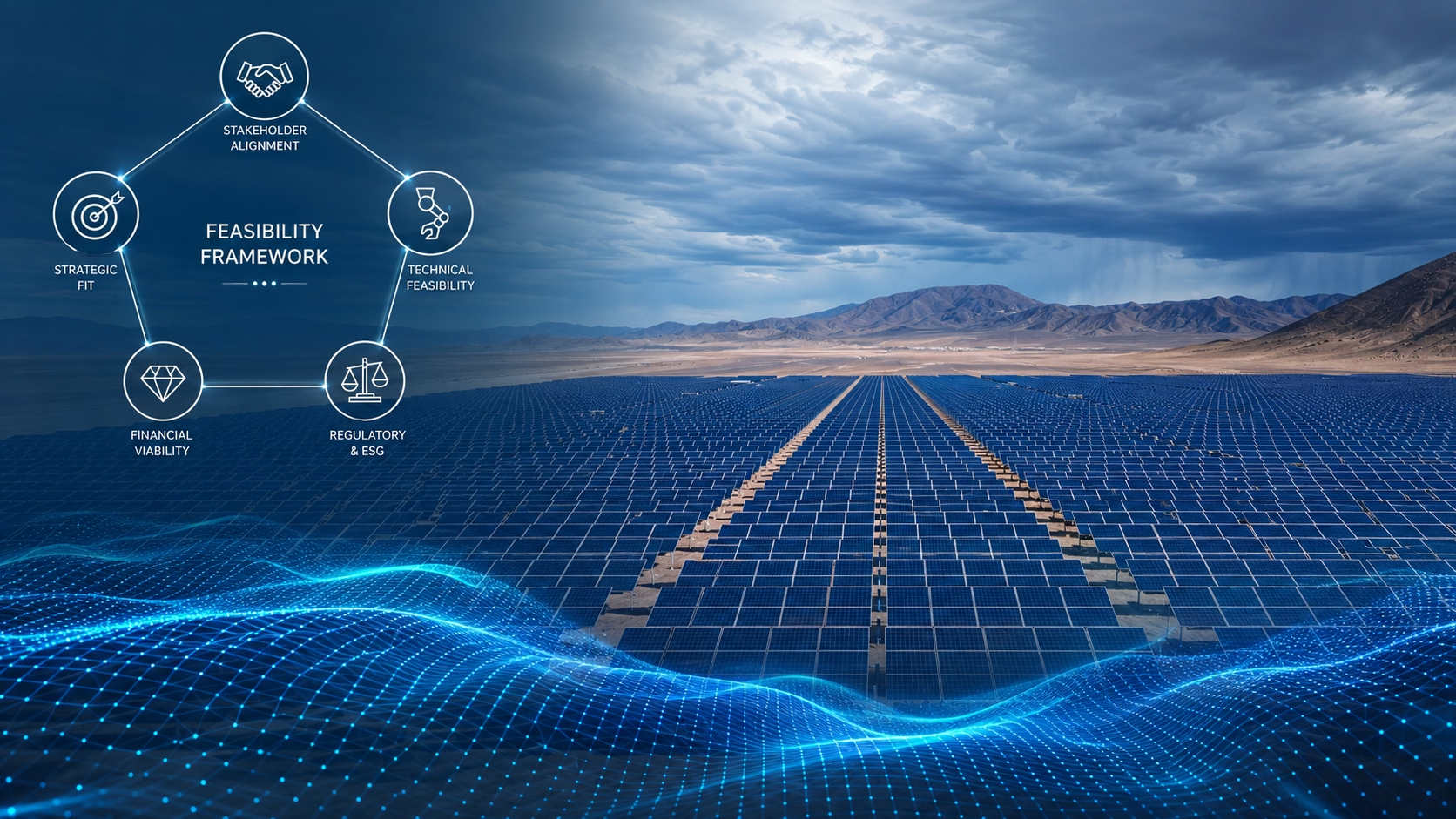
APS provides specialist engineering consultancy for solar photovoltaic (PV) projects, from commercial rooftop systems to utility-scale solar farms and hybrid renewable developments.
The service supports feasibility assessment, site screening, energy yield assessment, conceptual and detailed design review, grid integration studies, technical due diligence and independent engineering advisory. APS helps clients optimise performance, reduce technical risk and support informed investment decisions through structured, simulation-based engineering assessment.
Solar PV projects are strongly influenced by site conditions, solar resource, land availability, grid connection capacity, inverter behaviour, electrical losses, network constraints and long-term operational performance. Early-stage decisions on installed capacity, DC/AC ratio, module technology, inverter arrangement, export limitation, cable routing, transformer rating, earthing interface and grid connection strategy can significantly affect project viability.
APS provides feasibility and advisory services to help define the most appropriate development concept for the project. This may include review of available land area, solar irradiance, terrain, access routes, shading constraints, environmental limitations, proximity to the existing electrical network and suitability of the proposed point of connection.Where required, the study may consider geotechnical and environmental constraints, mounting structure suitability, drainage and terrain conditions, equipment access, construction limitations and sensitive land-use areas. The objective is to identify technical constraints at an early stage and establish a practical engineering basis for the next stage of development.
Energy yield assessment forms a core part of the PV project development process. APS uses historical meteorological data, site-specific assumptions and recognised simulation methods to estimate expected energy production, assess system losses and compare alternative plant configurations. PVsyst may be used as a primary PV performance modelling tool to evaluate irradiance, temperature effects, near-shading, horizon shading, soiling, mismatch, degradation assumptions, inverter losses, cable losses, transformer losses and other system-level losses.
For grid-connected PV projects, the assessment can be extended beyond energy yield and layout optimisation to include electrical design, grid connection compliance, load-flow performance, voltage control, reactive power capability, short-circuit contribution, protection coordination, harmonic performance, power quality and inverter-based resource behaviour.
APS supports early-stage project development by assessing whether a proposed site is technically suitable for solar PV development. The feasibility review may consider solar resource potential, available area, terrain, access, shading, grid proximity, planning constraints, environmental sensitivity, drainage, ground conditions and constructability.
The feasibility stage can be used to define the appropriate installed capacity, export strategy, self-consumption arrangement, connection voltage, preferred point of connection and high-level plant configuration. This helps developers and investors understand whether the project concept is technically viable before major design, procurement or connection commitments are made.
Energy yield assessment is used to estimate the long-term production potential of the PV plant and to identify the main technical factors affecting performance. APS carries out PV performance studies using meteorological data, site assumptions, module and inverter parameters, shading information and system-loss assumptions.
PVsyst modelling can be used to assess expected annual energy yield, performance ratio, specific yield, loss diagrams, inverter clipping, temperature losses, soiling assumptions, mismatch losses, cable losses, transformer losses and the impact of layout decisions. The results can support design comparison, financial modelling, technical due diligence and project documentation for developers, lenders and stakeholders.
For bifacial PV projects, the assessment may also consider rear-side irradiance contribution, ground albedo, row spacing, mounting height and tracker configuration where relevant. This allows the energy gain from bifacial technology to be reviewed against cost, land-use and layout constraints.
APS supports both conceptual and detailed PV system design. The design process may include selection of module technology, inverter configuration, mounting structure, plant layout, DC string arrangement, combiner box strategy, AC collection system, transformer sizing, switchgear requirements, cable routing and grid interconnection arrangement.
PV module selection may consider efficiency, degradation, technology type, bifacial gain, temperature coefficient, mechanical loading, availability, cost and suitability for the proposed site. Inverter selection may include central inverters for utility-scale solar farms, string inverters for flexible layouts and partial-shading conditions, or distributed inverter arrangements for commercial and industrial applications.
Mounting structure options may include fixed-tilt systems, single-axis trackers or dual-axis trackers depending on solar resource, terrain, land availability, energy-yield benefit, maintenance requirements and project economics. Plant layout design is developed to reduce shading, optimise land use, maintain access for operation and maintenance, and maximise solar energy capture.
APS supports the electrical design and grid integration aspects of solar PV projects. This may include assessment of DC and AC cable systems, inverter stations, transformers, switchgear, earthing interfaces, protection requirements, export limitation, metering, control philosophy and grid connection compliance.
For grid-connected projects, particular attention is given to safe and stable operation at the point of connection. Studies may include load-flow analysis, short-circuit assessment, reactive power capability, voltage-control strategy, protection coordination, harmonic performance, flicker assessment, power quality review and compliance with network operator requirements.
Where the PV plant is connected to a weak grid, private MV network, industrial facility, data centre or hybrid renewable system, additional assessment may be required to understand voltage stability, control interaction, inverter response, fault ride-through, transformer energisation, harmonic resonance and dynamic reactive power support.
APS can support PV projects where Battery Energy Storage Systems (BESS) are included as part of the development. Energy storage may be considered to improve self-consumption, reduce export limitation, provide peak shaving, support backup supply, improve grid stability, reduce curtailment or increase the commercial value of renewable generation.
Hybrid systems combining solar PV, BESS, wind generation, EV charging infrastructure, standby generation or industrial loads can be assessed to identify the most suitable operating strategy, energy balance, grid impact and technical limitations. The assessment may include active and reactive power control, charging and discharging strategy, transformer loading, cable rating, grid import/export limits, protection coordination and compliance with network operator requirements.
APS provides independent technical due diligence and advisory support for investors, developers, lenders and asset owners. This may include review of feasibility studies, energy yield assumptions, PVsyst models, design documentation, grid connection strategy, equipment selection, project constraints, technical risks and expected operational performance.
The independent review helps identify design weaknesses, unrealistic assumptions, grid connection risks, construction limitations, performance uncertainties and compliance gaps before major investment, procurement or construction decisions are made. The output can support lender review, acquisition assessment, owner’s engineering, project governance and technical decision-making.
APS provides study-led solar PV advisory and design services for projects requiring independent technical input, realistic performance assessment and reliable grid integration.
The objective of the study is to provide a technically justified assessment of electromagnetic interference, impressed voltage and corrosion-related risks before they become safety, design, compliance or operational issues.
APS combines practical site-testing experience with detailed electromagnetic modelling to help clients understand how nearby power infrastructure may affect pipelines, railways, buried metallic services and exposed conductive assets. The study can identify whether induced voltages, coating stress voltages, touch voltages, current densities or transferred potentials are within acceptable limits, and whether mitigation is required.
The assessment supports early design decisions, route selection, separation-distance review, asset protection, cathodic protection coordination, safety compliance and mitigation system optimisation. This allows project teams to move from uncertainty to a clear engineering position supported by modelling evidence, practical mitigation options and technically robust recommendations.