
Advanced Power Studies Contact Us
APS Specialist Studies

MV/HV Substation Design Primary and Secondary Engineering

Specialist engineering support for MV and HV substation design across both primary plant and secondary systems, covering AIS and GIS arrangements — from concept design and detailed design review through to grid connection and compliance assessment.
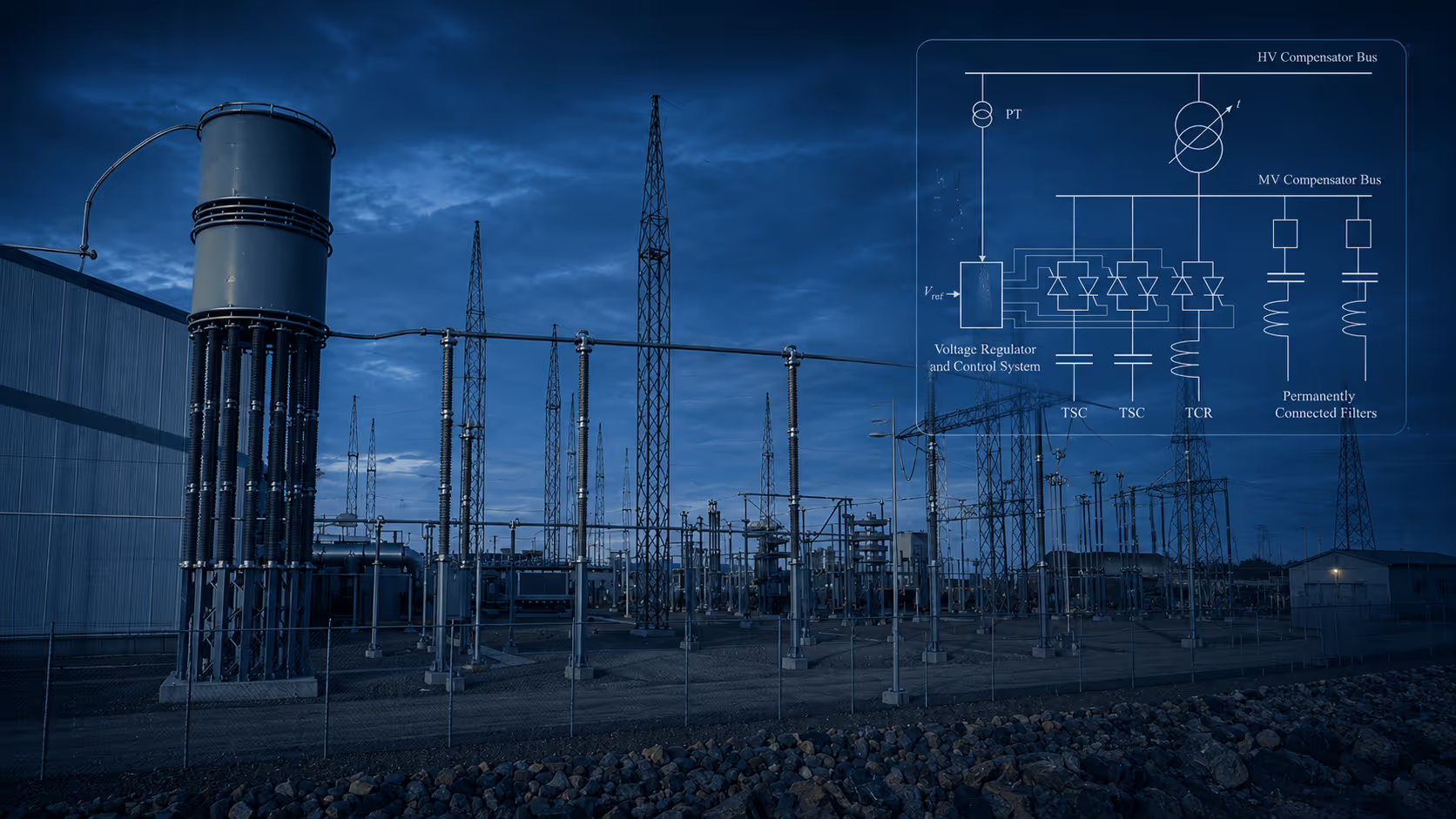
MV / HV / EHV substation design — primary and secondary systems and full design verification.
AIS · GIS · Hybrid — IEC · IEEE
Primary Systems / Secondary System
MV/HV Substation Design —
Primary and Secondary Engineering
Service Scope

MV/HV Substation Design — Primary and Secondary Engineering

Substation design requires coordinated consideration of electrical performance, safety clearances, equipment ratings, civil constraints, protection and control interfaces, earthing performance, cable routing, access requirements, maintainability and compliance with network operator requirements.

Overview

APS provides specialist engineering support for MV and HV substation design across both primary plant and secondary systems, covering Air-Insulated Switchgear (AIS) and Gas-Insulated Switchgear (GIS) arrangements. The service supports developers, utilities, industrial clients, EPC contractors and consultants during concept design, detailed design review, technical due diligence, grid connection development and compliance assessment.

Substation design requires coordinated consideration of electrical performance, safety clearances, equipment ratings, civil constraints, protection and control interfaces, earthing performance, cable routing, access requirements, maintainability and compliance with network operator requirements. APS applies practical engineering judgement together with recognised international and national standards to develop, review and verify robust substation design solutions.

The work is conventionally divided into two complementary disciplines. Primary design concerns the power-carrying apparatus and physical arrangement of the substation — switchgear, transformers, busbars, insulation, earthing and the safe spatial layout of plant. Secondary design concerns the protection, control, automation, metering and auxiliary systems that monitor, protect and operate that primary plant. APS supports both disciplines, and critically the interface between them, so that the completed substation is electrically sound, safe, operable and compliant as an integrated whole.

The design and review process draws on relevant standards and guidance including the IEC 62271 series for high-voltage switchgear, IEC 60071 for insulation coordination, IEC 60076 for power transformers, IEC 60909 for short-circuit calculation, IEEE Std 80 for substation earthing, ENA EREC S34 for UK earthing practice, the IEC 60255 and IEC 61869 series and IEC 61850 for protection, instrument transformers and substation automation, together with CIGRE technical brochures, ENA Engineering Recommendations, BS EN standards, DNO/TSO/DSO specifications and grid code requirements.

Primary Design

Primary design establishes the high-voltage architecture of the substation and verifies that every current-carrying component is correctly rated, adequately insulated, mechanically robust and safely arranged. APS provides engineering support across the full primary design scope — from concept layout and equipment sizing through to detailed rating verification, insulation coordination, earthing and civil interface review.

  • MV/HV AIS and GIS substation layout development and busbar configuration selection — single-busbar, double-busbar, H-arrangement, ring and mesh configuration options and their operational and connection implications More info
  • Single-line diagram review and development — equipment interconnection, interlock logic review and operational scheme verification More info
  • Primary plant selection and equipment sizing — transformers, switchgear, busbars, cables, surge arresters and associated primary equipment, reviewed against IEC 62271, IEC 60076 and applicable BS EN standards More info
  • Short-circuit current assessment and equipment withstand verification — fault current calculation per IEC 60909, peak making current, thermal and dynamic withstand verification for switchgear, busbars and connected plant More info
  • Dynamic and thermal busbar force calculations under fault conditions — electromagnetic and thermal forces on rigid and flexible busbar systems to verify mechanical adequacy of supports, clamps and fixings More info
  • Insulation coordination, clearance and creepage assessment — per IEC 60071, including switching overvoltage, lightning impulse and, for GIS installations, very-fast-front overvoltage (VFFO) considerations and their implications for equipment selection and protection coordination More info
  • Earthing, bonding and touch/step voltage safety assessment — earthing design and safety verification per IEEE Std 80, ENA EREC S34 and CIGRE practice, covering earth grid design, earth potential rise, touch voltage, step voltage and transferred potential assessment More info
  • Lightning protection and surge arrester coordination — shielding angle and rolling sphere analysis for lightning protection; arrester selection and coordination with insulation levels More info
  • Cable sizing, cable routing and trench/duct-bank arrangement review — HV and MV cable sizing and ampacity verification, routing review, segregation, duct-bank arrangement and thermal environment assessment More info
  • GIS/AIS interface review and equipment arrangement optimisation — interface engineering between GIS and AIS sections including bushing arrangements, transition connections and gas zone boundaries More info
  • Physical clearances, control building, access roads and operational access review — minimum electrical clearances per IEC 62271 and network operator requirements, equipment access for operations and maintenance, vehicle access and working envelope More info
  • Fire safety, oil containment and transformer bunding interface review — fire separation distances, oil-filled equipment containment, bund sizing and drainage interface with civil design More info
  • Maintainability and equipment replacement strategy review — assessment of the design against maintenance access requirements, equipment-change-out envelopes and operational constraints More info

Secondary Design

Secondary design delivers the protection, control, automation and auxiliary systems that make the primary plant observable, protectable and operable — and that together with primary design determine whether the substation meets its compliance and performance obligations. APS provides engineering support across the full secondary design scope, including the interface with primary plant that is the most common source of design integration issues.

  • Protection philosophy development and protection scheme design — main and backup protection principles, protection redundancy, busbar protection, transformer differential protection, feeder protection and inter-trip schemes More info
  • Protection coordination and grading studies, with relay setting calculations — time-current grading, fault level and reach verification, relay setting documentation and compliance with network operator protection requirements More info
  • Instrument transformer application, sizing and accuracy review — CT and VT/CVT specification and application per IEC 61869, burden assessment, accuracy class verification for protection and metering duty, and saturation assessment under fault conditions More info
  • Substation automation and control system architecture — IEC 61850 station bus and process bus design, GOOSE messaging and sampled-value interfacing for digital substations, bay controller and station-level architecture More info
  • SCADA, RTU and signal interface design — telecontrol interface between primary plant, local control and remote network management systems, including signal schedules and functional allocation More info
  • Interface and wiring engineering — schematic diagrams, wiring schedules, terminal and marshalling plans, panel-to-panel interconnection and cable schedules for secondary systems More info
  • Auxiliary AC/DC supply, battery and UPS system sizing and review — station battery capacity, battery charger sizing, DC distribution design, AC auxiliary supply and UPS sizing to support protection and control loads under all credible outage conditions More info
  • Protection, automation and control panel arrangement and integration — panel configuration, equipment layout, relay and IED integration, wiring practice and panel design review against project specifications More info
  • Metering, monitoring and condition-monitoring interface review — revenue and check metering specification, energy management interface, and integration of condition-monitoring systems for transformers, switchgear and ancillary plant More info
  • IED configuration data structuring and cybersecurity-aware design — IED application configuration, data modelling and cybersecurity considerations per IEEE 1686 and applicable network operator cybersecurity requirements More info
  • Compliance review against DNO, TSO, DSO and utility-specific requirements — review of the secondary design against connection offer conditions, network operator protection and control specifications, and applicable engineering recommendations More info

Typical Applications

These services are applicable to any project requiring independent engineering input into MV or HV substation design — whether new build, extension, refurbishment or modernisation — and to any project stage from feasibility through to construction support and commissioning verification.

  • New-build HV transmission-connected and grid connection substations
  • Primary distribution substations and HV/MV switching stations
  • Industrial HV and MV switchrooms and main intake substations
  • Renewable energy generation substations (wind, solar PV, BESS)
  • Data centre HV and MV switchrooms and power distribution infrastructure
  • HVDC converter station auxiliary and connection substation design
  • Brownfield substation refurbishment, extension and asset replacement
  • GIS and AIS modernisation, life extension and partial refurbishment projects
  • Digital substation design and IEC 61850 migration projects
  • EPC contractor and developer technical due diligence
  • Independent verification of third-party substation designs
  • Grid connection substation design for new and repowered generation

Technical Value

APS supports substation projects from early-stage feasibility through to detailed design review and construction support, across both primary and secondary disciplines and the critical interface between them. The objective is to confirm that the proposed MV/HV substation arrangement is technically sound, safe, maintainable, compliant with applicable requirements and suitable for reliable long-term operation.

By combining recognised IEC, IEEE, CIGRE and ENA practice with independent engineering judgement, APS helps clients de-risk design decisions early, identify rating and clearance limitations before they become construction issues, and resolve primary-to-secondary interface ambiguities before they become commissioning problems. The work produces clear, defensible technical evidence to support design review, connection approval, commissioning and asset management.

The primary-to-secondary interface is treated as an explicit part of the scope, not an assumed handover. CT saturation under close-up fault, VT secondary loading, DC auxiliary supply under battery-only conditions, protection reach under minimum fault level, busbar protection logic under GIS switching sequences, and VFFO implications for protection IED immunity — these are the issues that fall between disciplines in siloed working and are caught when both are in scope together.

Where projects require it, APS also provides technical due diligence and independent verification of third-party substation designs, assessing primary layout, equipment ratings, insulation coordination, earthing, protection philosophy and secondary systems engineering against the applicable standards, network operator requirements and project-specific employer’s requirements.