
United Kingdom
Click to view details
UK Registered Office
Address18 Canberra Road
Gretna, Dumfriesshire
Scotland
DG16 5DP
Gretna, Dumfriesshire
Scotland
DG16 5DP
Text can be selected and copied.
Specialist grid connection and compliance studies for renewable generation, BESS, data centres, substations and critical power infrastructure across Great Britain, Ireland and Germany.
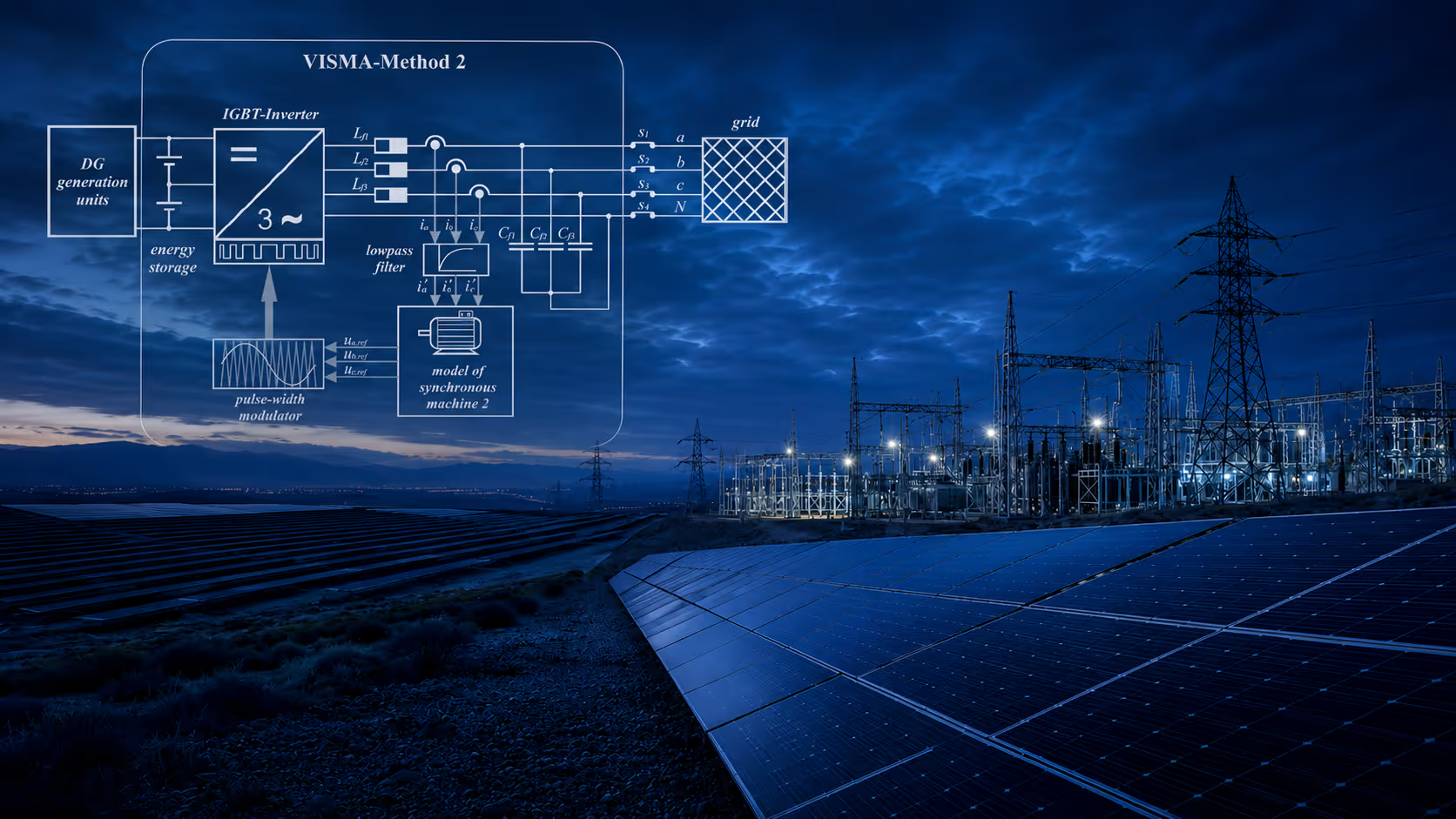
Power system studies for grid connection, compliance assessment, operational performance and technical risk management, delivered against the GB Grid Code, EirGrid Grid Code, VDE-AR-N technical connection rules and the EU Network Code on Requirements for Grid Connection of Generators.
APS provides specialist grid connection and compliance studies for renewable generation, battery energy storage systems (BESS), data centres, substations, industrial facilities and critical power infrastructure. Studies are delivered against the national grid codes and technical connection rules applicable in each jurisdiction, supported by recognised IEEE, IEC and CIGRE methodologies and carried out using DIgSILENT PowerFactory, EMTP®, PSCAD™/EMTDC™ and PSS®E.
The starting point for grid connection requirements across all three markets is the EU Network Code on Requirements for Grid Connection of Generators (Commission Regulation (EU) 2016/631, RfG), which classifies power-generating modules into Types A, B, C and D by voltage level and maximum capacity at the connection point, establishing baseline capability requirements for frequency response, fault ride-through, reactive power and protection that each national framework then refines and extends.
In Great Britain, connection requirements are set out in the GB Grid Code and, for distribution-connected generation and storage, ENA Engineering Recommendation G99. The NESO connection process governs Transmission Entry Capacity (TEC) applications, with the ongoing connection reform programme — including revised queue management and Transmission Impact Assessment (TIA) threshold changes — actively shaping requirements and process milestones through 2025 and 2026. APS supports clients in navigating current requirements and the reforms in parallel.
In Ireland, connection requirements are set out in the EirGrid Grid Code and the ESB Networks Distribution Code, implementing the EU Connection Network Codes. The Commission for Regulation of Utilities (CRU) approved the incorporation of HVDC parameters into the Ireland Grid Code, applying the European requirements in full. Connection applications are processed through the EirGrid and ESB Networks connection offer processes, with technical requirements applied by voltage level and capacity.
In Germany, technical connection rules are set out in VDE-AR-N 4110 (medium voltage), VDE-AR-N 4120 (high voltage) and VDE-AR-N 4130 (extra high voltage). The German regime also requires plant and unit certification, issued by accredited bodies such as VDE Renewables and TÜV NORD. APS provides the simulation, modelling and validation evidence needed to support the certification process, including studies aligned to FGW TR4 modelling and FGW TR3/TR8 testing documentation requirements.
Across all three markets, APS combines detailed power system modelling with practical engineering judgement to identify compliance risks, assess system limitations, evaluate mitigation options and produce clear technical evidence for design review, connection approval, commissioning and operational acceptance.
APS provides study-led grid connection services from early-stage feasibility through to post-connection compliance reporting. Each study is scoped to the applicable grid code requirements and delivered with the technical evidence needed to support connection applications, design reviews and regulatory submissions.
These studies are applicable across all generation, storage and demand technologies that require grid connection approval or ongoing compliance demonstration, particularly where voltage level, connection capacity or technology type triggers Type B, C or D obligations under the EU RfG or its national implementing rules.
The objective of the study is to provide a technically justified, grid code-aligned assessment of connection compliance, system performance and risk before issues become obstacles to connection approval, commissioning acceptance or operational authorisation.
APS combines detailed power system modelling with practical engineering judgement to help clients understand where compliance risks lie, what the grid code requires, and what the evidence needs to look like for the relevant network operator or certification body. The study identifies whether load flow, fault level, ride-through, frequency response, harmonic and stability performance are within the limits set by the applicable grid code — and where they are not, what mitigation or design change is required.
The assessment supports early feasibility, connection offer negotiations, technical due diligence, design review, pre-commissioning compliance verification and post-connection operational acceptance. It produces clear technical evidence aligned to the formats expected by NESO, EirGrid, ESB Networks or the relevant VDE-AR-N certification body — allowing project teams to move from uncertainty to a documented engineering position, reducing the risk of connection delays or condition non-compliance.
By combining simulation in DIgSILENT PowerFactory, EMTP® and PSCAD™/EMTDC™ with current grid code requirements, validated plant models, fault level data, network impedance and connection conditions, APS helps clients secure connections, satisfy compliance obligations, optimise plant settings and demonstrate that grid code requirements have been properly addressed across all applicable study areas.