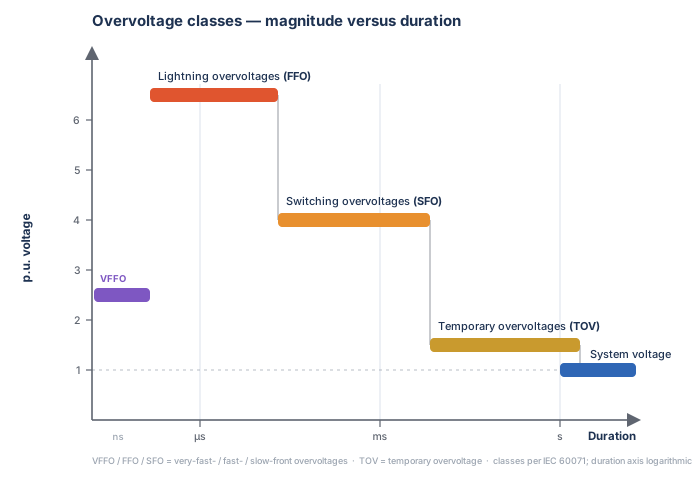
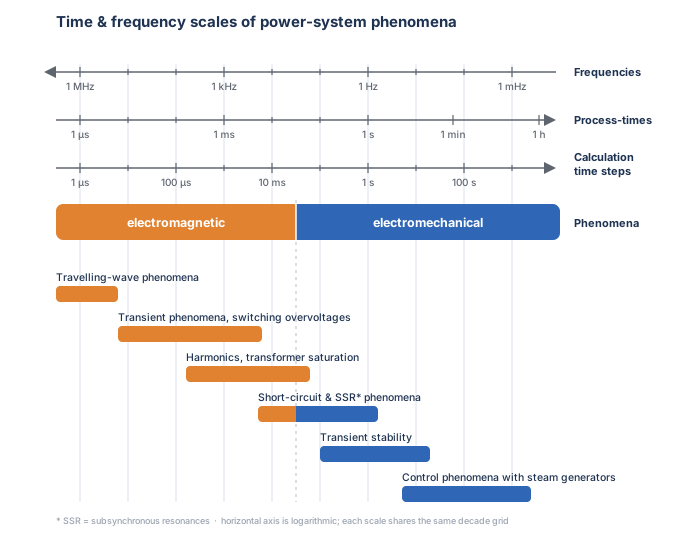
Temporary overvoltages are low-frequency overvoltages at or close to power frequency, usually longer in duration than switching or lightning overvoltages. The typical range of shapes is a frequency of 10 Hz to 500 Hz and a duration \(T_t\) from 0.03 s to 3600 s. The standard short-duration power-frequency withstand test is generally based on 48 Hz to 62 Hz and a duration of 60 s, unless the relevant equipment standard specifies otherwise.
The word temporary describes the duration, not the severity — a sustained power-frequency overvoltage of only about 1.3–1.5 p.u. can overheat a surge arrester or saturate a transformer core in a way that a far higher but microsecond-long impulse never would. Temporary overvoltages are important because they set the power-frequency insulation stress, and because they govern the energy capability and thermal withstand of metal-oxide surge arresters (MOSA) — the zinc-oxide, gapless arresters that protect equipment by conducting heavily only above a threshold voltage and so clamping the overvoltage to a known protective level. An arrester may be correctly rated for lightning or switching impulses yet still be overstressed if the system TOV is too high or lasts too long. TOVs can also stress transformers and shunt reactors through over-fluxing: when the volts-per-hertz (\(V/f\)) ratio becomes too high, the core flux becomes excessive, raising the magnetising current and causing heating, vibration and possible damage if the condition is severe or sustained.
The earth-fault factor — the headline TOV case
The classic source of temporary overvoltage is a single-line-to-earth fault: the voltage on the healthy phases rises by the earth-fault factor, which depends on the system earthing (the \(X_0/X_1\) and \(R_0/X_1\) ratios). It is typically up to about 1.4 in effectively earthed systems and can approach \(\sqrt{3}\) in isolated or resonant-earthed systems. The earth-fault factor, the fault duration and the protection clearing time together set the TOV stress on equipment and arresters.
Typical sources of temporary overvoltage include load rejection, transformer energisation, parallel-line resonance, uneven circuit-breaker pole operation, backfeeding, fault application and fault clearing. Ferroresonance is a special form of temporary overvoltage involving the interaction of nonlinear inductance, capacitance, low damping and system switching; because it has its own modelling requirements and can produce complex sustained oscillations, it is usually treated as a separate study topic.